Mapping Indigenous Wellbeing: A Scoping Review for Decolonial Public and Global Health
The Pilina Center is honored to share a new review, A Systematic Scoping Review for Decolonial Public and Global Health: Indigenous Frameworks and Models of Wellbeing from Turtle Island and Moananuiākea, is now published in Frontiers in Public Health. This work maps 33 Indigenous-developed models and frameworks of wellbeing from across Turtle Island (North America) and Moananuiākea (the Pacific), celebrating Indigenous excellence and offering guidance for a public health rooted in relationality, land, and self-determination. The Pilina Center is proud to have contributed to this work through Jo, Aubrey, Caleb, Val, and Mapuana.
A Kākou Effort
This review was a kākou effort from beginning to end. The all-Indigenous research team, with genealogies and ties spanning Turtle Island and Moananuiākea, brought together expertise in Native Hawaiian and Indigenous health, wellbeing, clinical and community psychology, public health, culturally sustaining education, and library and information sciences. Every stage, from defining the inclusion criteria to affirming the final themes, was shaped through collective discussion and consensus. The seven themes that emerged from the analysis were reviewed by the full team, whose shared knowledge of our regions affirmed their cultural resonance and analytic integrity.
The hui reflects the very regions this review honors. Lead author Jo Qinaʻau is Kanaka ʻŌiwi, Ainu, Irish, Japanese, and Portuguese, born and raised on Oʻahu, and approaches this work as a clinical psychologist offering research as ritual to heal backward for kūpuna and vision forward to Indigenized futures. Aubrey Yanger Mariano is a CHamoru scholar born and raised on Guåhan, and Cerila Rapadas is a Filipino and CHamoru daughter of Guåhan training in clinical psychology in Hawaiʻi. Melissa Kahili-Heede and Mapuana C.K. Antonio are Kanaka ʻŌiwi scholars grounded in aloha ʻāina and kuleana to community. Selah Kone is Alaska Native (Sugpiaq/Unangax̂) from Kodiak Island. Caleb Rivera brings insider knowledge as a community member and researcher whose ancestors sustained Indigenous wellbeing traditions for centuries. Shayla Chatto is a Diné (Navajo) and N'dee (White Mountain Apache) scholar guided by the teaching of Hózhó. Valerie J. Clack is an enrolled member of the Oglala Sioux Tribe, raised with intertribal traditions in the lands of the Wintu and Pit River Nations. Finley Ngarangi Johnson carries Māori (Rongomaiwahine, Ngāti Kahungunu, Rongowhakaata) and Indian ancestral connections in Aotearoa. Michelle Johnson-Jennings is a Choctaw Nation tribal citizen and clinical health psychologist whose decades of work advance community-driven Indigenous health. Together, these genealogies form a living bridge across Turtle Island and Moananuiākea, the same bridge that grounds the review's scope.
We approached this work as research as ceremony. Meetings began with protocol and meditations from our respective cultures, honoring the inherent spirituality in life itself, including our research huakaʻi (journey). We used our time together to nourish pilina through talk story and to explore the reciprocal and community benefits of our efforts. The relationships built along the way are honored as being equally important as the review itself.
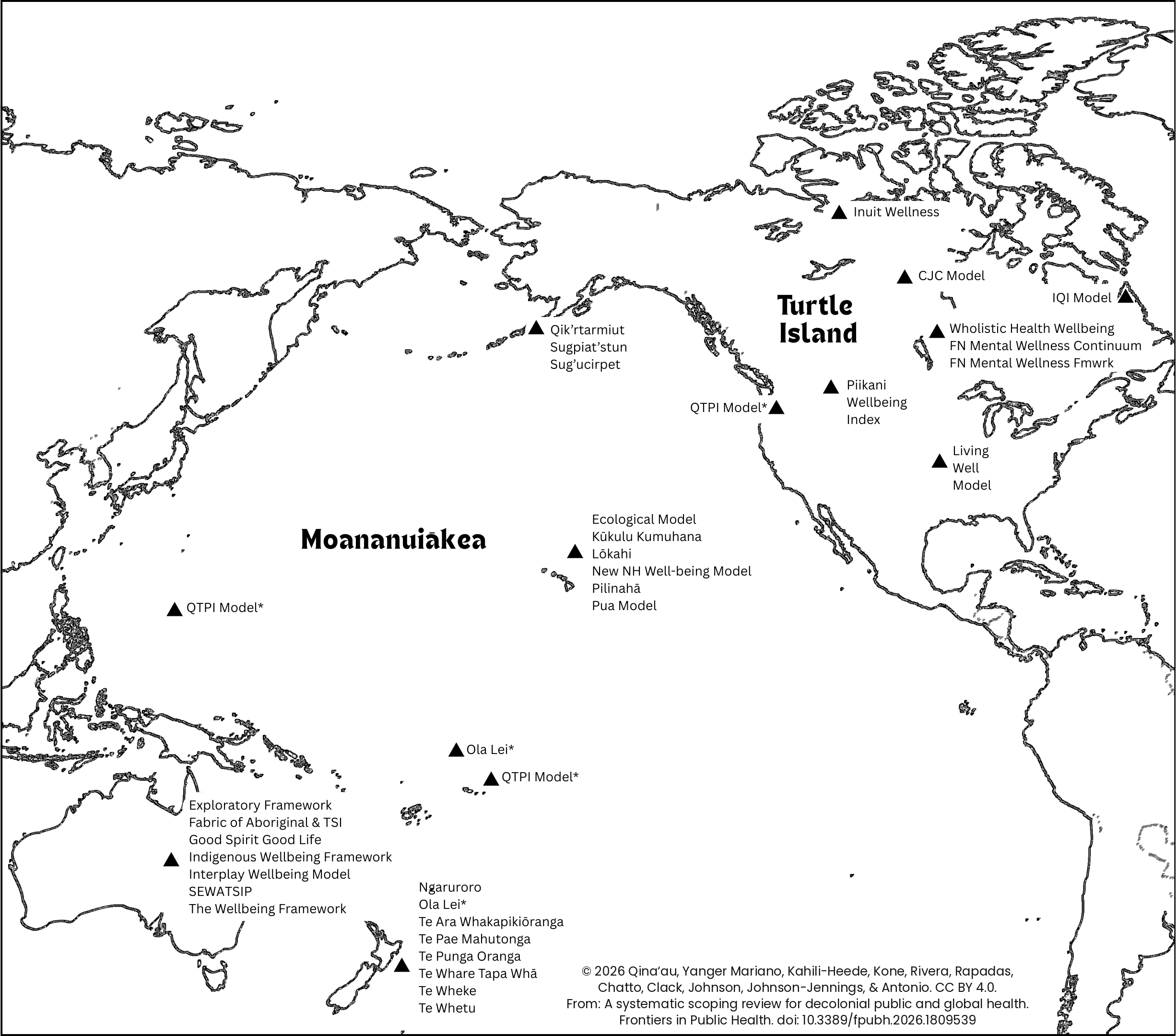
Map of Indigenous models and frameworks of wellbeing from Turtle Island and Moananuiākea.
Indigenous Approaches, Rigorous Methods
The review was conducted by, with, and for Indigenous communities, guided by the transformative paradigm, an Indigenous approach to research that names the transformation of systems toward equitable power as a primary goal. It is positioned as part of the movement to decolonize public and global health, centering Indigenous ontologies, epistemologies, axiologies, and praxes as valid and vital sources of knowledge.
Indigenous approach and methodological rigor walked hand in hand. The review followed JBI scoping review methodology, was reported in accordance with PRISMA-ScR guidelines, and was registered on the Open Science Framework. Searches across five databases, professional networks, and grey literature identified over 1,500 unique records, with 33 manuscripts ultimately included. The team also honored data sovereignty in decisions about grey literature, respecting communities' authority over their own models and knowledge.
What We Found
Every one of the 33 models and frameworks included relationality and culture as aspects of wellbeing. Synthesis across the models yielded seven themes: holistic integration of all life domains; spirituality and the ongoing presence of ancestors; culture and preservation of tradition; collective wellbeing and relationality; land as a source of identity, health, and responsibility; place-specific Indigenous metaphors and language; and empowerment and self-determination.
These frameworks stand in contrast to dominant Eurocentric approaches that compartmentalize wellbeing and center the individual. Across Turtle Island and Moananuiākea, Indigenous communities articulate wellbeing as relational, ecological, spiritual, and collective, inseparable from ʻāina, ancestors, and community. In the paper, we discuss the importance of centering Indigenous models and frameworks of wellbeing at all levels of decolonial theory (ontological, epistemological, axiological, praxis) for public and global health.
Toward Community Wellbeing and Sovereignty
The purposes of these models cluster around re-centering Indigenous determinants of health, restoring self-determination and community control, building practice and system capacity, and strengths-based transformation over deficit remediation. Their future directions call for Indigenous-led measures (such as Kukui Mālamalama), intergenerational knowledge transmission, and strengthened Indigenous governance and data sovereignty.
The message from communities is clear: it is time to move from conceptual discussion toward tangible application. Global and public health cannot be decolonized without Indigenous self-determination and representation from theory to practice. These frameworks offer guidance for health systems, policymakers, and communities seeking care that is relational, holistic, and culturally safe, in service of equity and ea (sovereignty, life, breath) for generations to come.
Mahalo nui to the entire hui: Joanne Qinaʻau, Aubrey Yanger Mariano, Melissa Kahili-Heede, Selah Qasataisqaq Kone, Caleb Rivera, Cerila Rapadas, Shayla Chatto, Valerie J. Clack, Finley Ngarangi Johnson, Michelle Johnson-Jennings, and Mapuana C.K. Antonio.