
Hoʻomana i ka Naʻauao
The Pilina Center is committed to the wellbeing and empowerment of Kānaka ʻŌiwi (Native Hawaiians), the Indigenous peoples of Hawai'i. If you are interested in a collaboration in service of the lāhui, connect with us here.
For updates on ʻŌiwi-centered projects, visit our News page.
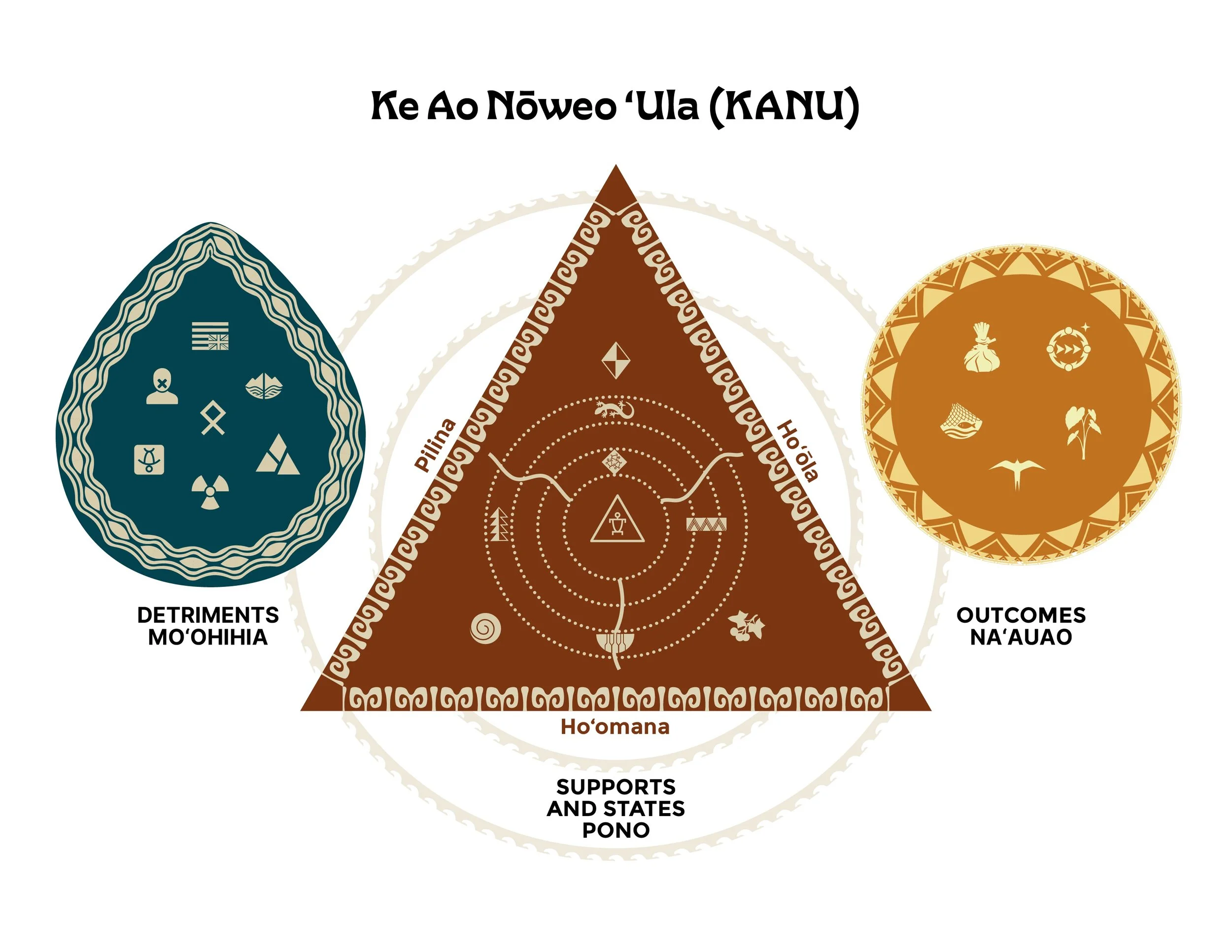
The Pilina Centerg is honored to share the development of Ke Ao Nōweo ʻUla (KANU)—the first community-rooted theory of Kanaka ʻŌiwi wellbeing designed for behavioral health contexts. KANU, meaning “the new dawn that shines bright,” articulates an Indigenous theory of mauliola (wellbeing) that emerges from the relational, cyclical, and intergenerational ecology of connection with ʻāina, ʻohana, community, culture, and spirit. Grounded in the lived experiences and voices of Kānaka ʻŌiwi clients, cultural practitioners, and health providers, this theory maps both supportive and detrimental processes to illuminate pathways of pilina (connection), hoʻōla (healing), and hoʻomana (empowerment). With an emphasis on pono (equity and balance) and decolonization, KANU offers a transformative foundation for culturally safe wellbeing, honoring ancestral knowledge while guiding contemporary behavioral health practice and systems change. Explore more here.
Temporary reference:
Qinaʻau, J. (2024). Hoʻomana i ka mauli ola: Transformative approaches to decolonial and Indigenized wellbeing for Kānaka ʻŌiwi [Doctoral dissertation, University of Hawaiʻi at Mānoa]. https://scholarspace.manoa.hawaii.edu/items/387d8bd9-278f-4460-9deb-2abfb20abcf3

Kukui Mālamalama is a community-grounded initiative to develop a culturally valid measure of mauli ola (wellbeing) for Kānaka ʻŌiwi (Native Hawaiians)—one that reflects Indigenous ways of knowing, being, and relating rather than relying on Western, Eurocentric frameworks. Many existing measures overlook the ongoing impacts of settler colonialism, the centrality of ʻāina, and the spiritual dimensions essential to Indigenous thriving. Guided by a transformative, mixed-methods approach and a Kānaka ʻŌiwi community advisory board, Kukui Mālamalama was developed with a Community Advisory Board from six Kanaka ʻŌiwi wellbeing models and refined through expert review, cognitive interviews, and community-based validation. The resulting preliminary measure includes three interconnected domains—kanaka (individual), ʻohana (family), and kaiāulu (community)—and centers respondent values through culturally responsive weighting questions. Early findings demonstrate strong face, content, and convergent validity, and the measure has already been applied in culturally sustaining evaluation work, including its use with Papa Ola Lōkahi’s Ola Ka Huakaʻihele o Hiiaka program. Together, this work offers a pono, Indigenous-grounded foundation for wellbeing research, evaluation, and program design across community, nonprofit, health, and academic settings. (Kukui Mālamalama logo by Pōhai Studios)
Temporary reference:
Qinaʻau, J. (2024). Hoʻomana i ka mauli ola: Transformative approaches to decolonial and Indigenized wellbeing for Kānaka ʻŌiwi [Doctoral dissertation, University of Hawaiʻi at Mānoa]. https://scholarspace.manoa.hawaii.edu/items/387d8bd9-278f-4460-9deb-2abfb20abcf3
Pilina Center completed the Kūkulu Kumuhana Contemplative Practice pilot - now named Pilina Welo. Funded by the Kūkulu Kumuhana Working Group (KS, LT, OHA, Consuelo Foundation, UH), Jo developed a program of culture-based practices to support Kānaka ʻŌiwi wellbeing using the Kūkulu Kumuhana framework for 130 community members.